

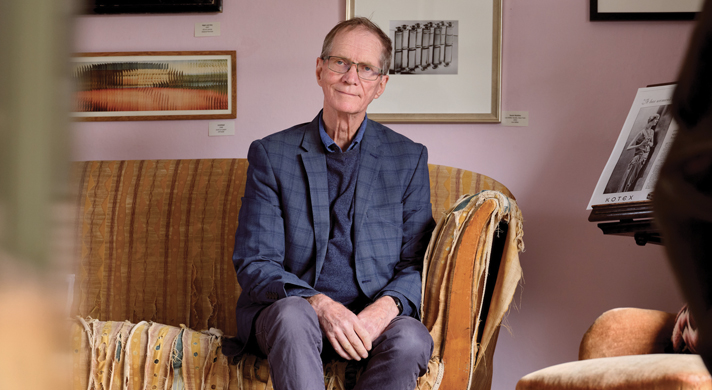
Antony Penrose: The Lives of Lee Miller
Antony Penrose has spent the last 40 years dedicated to the life and work of Lee Miller: muse, model, wife, surrealist photographer, war correspondent – and also his mother. After their difficult relationship in life, he only began to understand her after her death, he tells Pippa Duncan.
As Antony Penrose shows me around his childhood home, Farleys, in East Sussex, he tells me about the discovery of the archive of Lee Miller’s photographic work hidden in the attic after she died in 1977. It was the beginning of a journey to discover the person behind this remote figure: ‘It was not so much a choice, but a compulsion to find out more about this woman who was my mother, although I didn’t recognise her as that – I hardly knew her.’
An American, Lee Miller started her varied career as a muse, going on to become a highly sought after model. As a Surrealist photographer in Paris in the 1920s she became the lover of photographer Man Ray and together they invented the technique of solarisation. She mixed with fellow Surrealists, Paul Éluard and Jean Cocteau and, in 1934, married Egyptian businessman, Aziz Eloui Bey. But bored in Egypt, she left him in 1937.
At the outbreak of WWII, she turned from model for Vogue, to their war correspondent, photographing the London Blitz, the siege of Saint-Malo and the liberation of Paris. She saw many atrocities and was one of the first people to enter and photograph Dachau.
Miller gave birth to Antony just two years after the end of the war and he knew none of this as he grew up – he just saw a mother who didn’t seem to want to be one. He tells me: ‘I think very early on she recognised that there was something in her that failed to engage with the usual maternal qualities. It didn’t feature for Lee. She was carrying such a load of post-traumatic stress disorder.’ She became an alcoholic and the two things fuelled each other. ‘She never spoke of her war experiences at all.’
His father was Roland Penrose, the Surrealist painter and he grew up surrounded by art and artists. Picasso, Max Ernst, Man Ray and Joan Miró were all visitors and, as he enthusiastically shows me from room to room at the house, their work adorns the walls – a Picasso lithograph in the kitchen, a Henry Moore, Leonora Carrington and Eileen Agar. Picasso would take him to feed the bull: ‘Picasso was fun. The way to get the best out of him was to be a child or an animal. He treated both with the same sort of affection.’
‘Man Ray was really significant in my life. He was not child-friendly, but when I was about 14, I began to connect with him. He was very kind to me.’
He and his mother first attempted to build a relationship when he was around the same age and became interested in photography. ‘She let me be part of that. It was a time when she felt safe and comfortable enough to relate to me.’
Penrose walks me through rooms not open to the public. I see his childhood bedroom – now with a large table covered with prints to be sent out to buyers. We move on to the only air-conditioned room in the house. It holds the archive of her contact sheets and prints. I ask him if he has a favourite image. The most recognised is of Lee sitting in Hitler’s bath in Munich, 1945, her boots still covered with the dust of Dachau and a photo of the Führer propped against the wall. She only heard a few hours later that Hitler was dead.
But his favourite image is from her time in Egypt: ‘It is called Portrait of Space (Near Siwa, 1937). It’s a view through a torn fly screen of a piece of desert. And in the distance you can see some hills. And above, in the sky, there’s a cloud that looks as though it could be a bird. And for me, it’s this longing for freedom. I’ve always felt that’s her gift. For us to populate that space with whatever dreams and imaginings we may have.’
Kate Winslet, star of the film, Lee, spent days in this room, he says. ‘She researched for nine years in between other projects. She asked very penetrating questions and was just the most amazing person to work with. She looks uncannily like Lee and has her best qualities – she’s emotionally and physically brave.’
At the end of her life, he became closer to his mother. ‘We talked about lots of things.
Except those important things, we never talked about them.’
As he walks me to one of the galleries holding her work, I ask him what he would ask her, if he could talk to her now. He thinks for a moment, then says: ‘I’d ask her about the why. Why were you so secretive about all these things?’ He comes back to this question a little later and says ‘I’d say to her ‘I want you to tell me what I don’t know’.’
Because, despite dedicating the last 40 years of his life to her, there is still so much mystery to Lee Miller, so much he doesn’t know, despite interviewing her friends, people she worked with and those she photographed.
And then this 79-year-old sits at the gallery till, which he mans during the lunch hour, chatting to visitors about the stories behind the photographs, to people who have no idea who he is and how much this all means to him.
Antony Penrose will be at Barnes BookFest, 20 September.
barnesbookfest.org
farleyshouseandgallery.co.uk
Open until 30 Oct, Thurs, Fri, Sun.
Pippa Duncan
Image, © Lee Miller Archives Antony Penrose at Farleys. Courtesy Jim Holden