

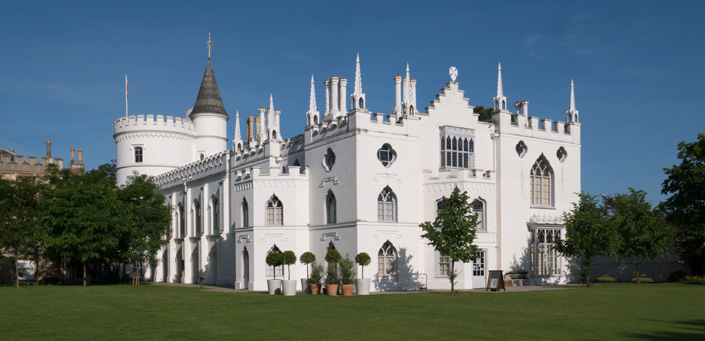
Horace Walpole was an eminently regarded member of 18th century society, knowledgeable in architecture, literature and art. He built the first Gothic villa, Strawberry Hill, in Twickenham
Horace Walpole was born in 1717, the youngest son of Sir Robert Walpole, Britain’s first Prime Minister. He was a mainstay of society at that time, with many influential friends. He is particularly remembered for two things: first, his voluminous correspondence and letters, which were published by Yale University Press in 48 volumes and, secondly, for the building of the Gothic style villa, Strawberry Hill, in Twickenham. He also wrote the world’s first Gothic novel, The Castle of Otranto, set in the Middle Ages, printed on his own printing press in the grounds of the house.
While Walpole may have intended the building of Strawberry Hill as a kind of diversion for him and his immediate circle of connoisseurs, its subsequent influence was very important in the development of the Gothic revival. He and his friends John Chute and Richard Bentley, the so-called Committee of Taste, converted Strawberry Hill from an ordinary cottage to a Gothic villa over a number of years.
Walpole was seeking to build something that was a cross between an abbey and a medieval castle. He was not an architect himself but used a number of different architects and builders. Initially, starting in 1750, he used the well-known architect, William Robinson. Not wholly satisfied with his wok, Walpole then employed other architects including his friends Chute and Bentley, who were both talented amateurs.
There was a deliberate sense of historicism in the design and naming of the rooms. Bentley designed the screen for the Holbein Chamber, based on a screen in Rouen Cathedral and was where Walpole kept his Holbein paintings and drawings. Chute designed the rich fan-vaulted ceiling in the Long Gallery. A number of other architects were involved, including Robert Adam, who designed the Gothic ceiling and fireplace in the Round Drawing Room.
Work on Strawberry Hill continued until Walpole’s death in 1797. The house then passed through various hands in the 19th century including Lady Waldergrave, who made a number of changes. In 1923, St. Mary’s Catholic Teaching Training College bought the house and the college greatly extended the number of buildings around Strawberry Hill. In 2014 the college become St. Mary’s University.
Walpole’s Gothic villa is now let by The Strawberry Hill Trust, a charitable trust. on a long lease. The Trust has beautifully restored it with the help of a Heritage Lottery grant and the house is open to the public.
You can find more local history articles here.