

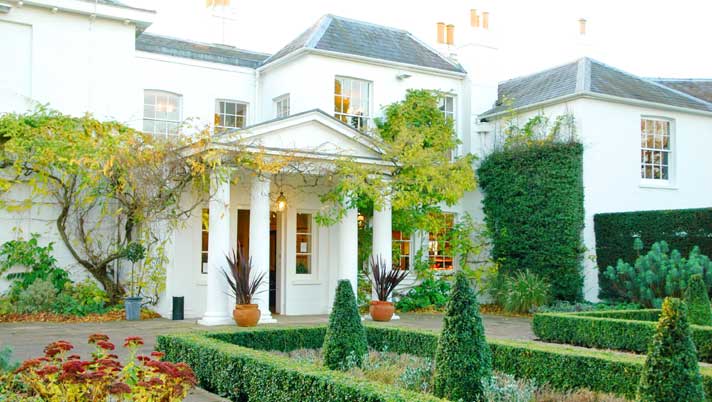
Now better known as a lovely spot for a cup of tea, after a stroll round the park, Pembroke Lodge in Richmond Park has had an interesting history
Pembroke Lodge is set in a magnificent garden in Richmond Park, overlooking the Thames Valley. Until 1850, Richmond Park was still a private royal park used for hunting. The Lodge was originally a small cottage, called Hill Lodge, let to the molecatcher, which was an important position as mole hills were a dangerous hazard for unwary huntsmen.
In 1787 George III let the Lodge to his friend, the Countess of Pembroke. She then had it substantially altered and enlarged. She employed John Soane, who was to become one of the country’s leading architects, to supervise the work. What we see today is basically the work carried out by Soane, which took 10 years (though some changes have been made since) and it became known as Pembroke Lodge. Lady Pembroke died in 1831, aged 93, and it then had a number of different occupants over the years.
In 1847 Queen Victoria gave the Lodge to Lord John Russell (Later Earl Russell), a leading Whig statesman who had brought in the Great Reform Bill. He occupied it until his death in 1878 and his widow stayed on for a further 20 years.
The philosopher Bertrand Russell, Lord John Russell’s grandson, spent much of his childhood there. During this period a number of leading literary figures such as William Makepeace Thackeray, the author of Vanity Fair, Charles Dickens and Alfred, Lord Tennyson, were guests here. Dickens was a regular visitor and even stayed overnight. In her biography of Dickens, Claire Tomlin writes that, aware of his hosts’ abstemious habits, Dickens brought his own bottle of punch to be drunk at bedtime. However, his hosts’ valet, on unpacking Dicken’s portmanteau, brought the bottle downstairs, much to Dicken’s embarrassment.
In the Second World War, the army requisitioned the Lodge for use as GHQ (General Headquarters) Liaison, but it was mores unofficially known as the Phantom Regiment due to the secret work that went on there. The unit was set up in 1939, but it was to play its most important role after D-Day, when its members would be attached to various army formations. Their actual role was to send out regular information to army GHQ about the positions of the army units in the front line. The officers of the Phantom Regiment included the actor David Niven, Michael Oakshott, who later became professor of Political Science at the LSE, Nigel Bridge, a future Lord of Appeal and Sir Robert Mark, later a Commissioner of the Metropolitan Police. Today Pembroke Lodge has a quieter role – it is a popular tea room and a beautiful spot as a wedding venue.
(c) John Moses
Find more local history stories here.