

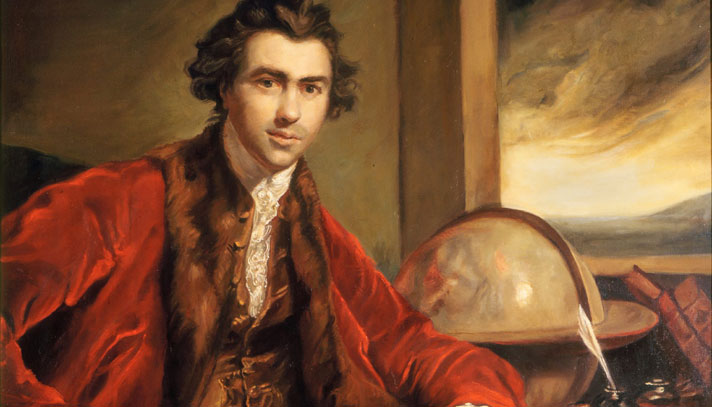
SIR JOSEPH BANKS – THE GODFATHER OF THE ROYAL BOTANIC GARDENS Kew
Sir Joseph Banks (1743-1820) was responsible for laying the foundations of the present botanic gardens at Kew. He was a rich landowner, who was free to do what he wanted and became fascinated with botany at Oxford, though left without a degree.
In 1768 the Royal Society (an independent scientific academy) organised an expedition to the South Seas, under Captain Cook, to observe the transit of Venus in 1769. Banks was able to persuade the Society to allow him to join this expedition and bring a team of artists and scientists. The fact that he had taken part in a scientific expedition to Newfoundland and Labrador in 1763 (the year he became a member of the Royal Society) may have persuaded the Society to agree.
Captain Cook dropped anchor at Tahiti so that Banks could make his observations. While there, he collected many important botanical specimens, but he was also admired for developing a strong relationship with the Tahitians, learning their language and customs and even taking part in their rituals.
Cook had secret orders to confirm the existence of what is now Australia, which he did by sailing up the east coast.
In 1771 the expedition returned, but 38 of the crew and some of Bank’s team died on the voyage. In 1772, Banks was invited to take part in Captain Cook’s second expedition, but at the last moment refused to do so, because he regarded the cabin, which he had been offered, as insufficient. It was about this time he was introduced to George III, who formed a close friendship with him. The royal gardens at Kew were much larger than the present gardens. The King was interested in making improvements to his properties and gave Banks a free hand to arrange the collection of plants from all over the world for the royal garden, much of which was paid for by the Admiralty.
In effect, Banks became the unofficial director of Kew, and his plant gatherers collected some 11,000 botanic specimens. One of his most important achievements was his plant hunting policy and today plant gatherers from Kew still go out to collect botanical specimens.
Banks was also active in very many other fields, becoming President of the Royal Society in 1778, which he continued until his death. He was also largely responsible for promoting Australia as a penal colony. Once established, it was realised that one of the ways the colony could be made profitable was through breeding of sheep, particularly Merino sheep. With the King’s encouragement, he bred the first English flock of Merino sheep in the royal gardens at Kew.