

While you sit at home getting cosy this autumn, why not start planning your holiday for next year? Don’t want to travel too far when things are still uncertain? The Camargue area of France has wild, open spaces, but great restaurants and culture, too, writes Solange Hando
As the river Rhône approaches the Mediterranean, it splits into the Grand Rhône and the Petit Rhône to form one of the largest deltas in Europe. This is the Camargue, an enticing place unlike anywhere else in France, where marshlands and lagoons glisten in the sun, fringed by broad windswept sands to the south, while paddies, orchards and wheat spread on the fertile plain.
But the deeper you head into the Carmargue delta, the wilder the land, strung with lakes and dunes, deserted beaches, sand bars, meadows and ponds festooned in tamarisks and yellow irises – and at the heart of it all, the saltwater lagoon of Vaccarès, which looks almost like a sea. Orchids and forget-me-nots offer a splash of colour, while delicate sand lilies, golden immortelles and sea lavender flutter in the breeze. With just ten inhabitants per square kilometre, these are vast open spaces and, although there are a few roads, the more isolated areas are easier to reach on horseback, as the locals do. There are guesthouses and stables where anyone can learn to ride or join a guided trek to enjoy a landscape with no boundaries.
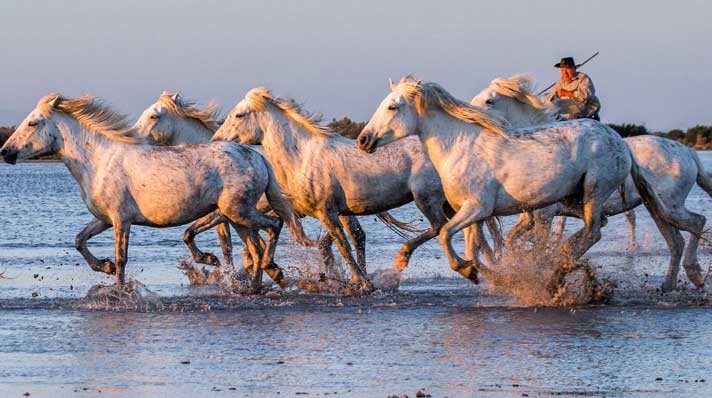
The Camargue has a character all of its own, steeped in age-old culture and traditions. You’re sure to come across a paddock where white Camargue horses gallop semi-wild, manes flying in the wind, or you might find a whitewashed traditional cottage thatched with reeds and shaped like the prow of a boat to withstand storms, or a ranch called ‘manade’ where black bulls are bred for the gameof ‘cocarde’.
The protected wetlands and coast attract around 350 bird species, from raptors and waterfowls to song and sea birds. Magpies and jackdaws are common but it’s always a treat to spot a colourful bee-eater or crested hoopoe. But above all other birds, pink flamingos, wading in shallow lagoons, amazingly peaceful until something disturbs the peace and the whole colony takes flight. In the spring, thousands of fluffy white chicks are born as it takes years for them to turn pink.
Don’t expect glittering resorts, for this is still wild land. Look out for the lonely walled village of Aigues-Mortes, once a sea port, now inland, and Les-Saintes-Maries de la Mer, with its 8,000 residents and the capital of the Camargue, where gypsies from far and wide honour their patron saint on an annual pilgrimage.