

All this talk of Christmas has enlivened the debate about our tree – whether we’ll drag out the fake one for another year or go fresh. There are advantages either way, but it got me thinking about some other Christmas plants – and one or two may surprise you!
Christmas cactus (Schlumbergera truncata) Flowers produced at the stem tips in autumn and winter are usually in shades of purple, pink or red. Although this plant is endemic to a small mountainous region of coastal sub-tropical Brazil, it’ll grow happily in our centrally heated homes, if we follow some basic rules. Wilted or limp Christmas cactus is sometimes caused by a lack of water or too much direct sunlight. If you’ve neglected to water the limp Christmas cactus, begin by giving the plant a limited drink. Continue to water sparingly every few days until the soil is lightly moist. Be kind, or it will sulk.
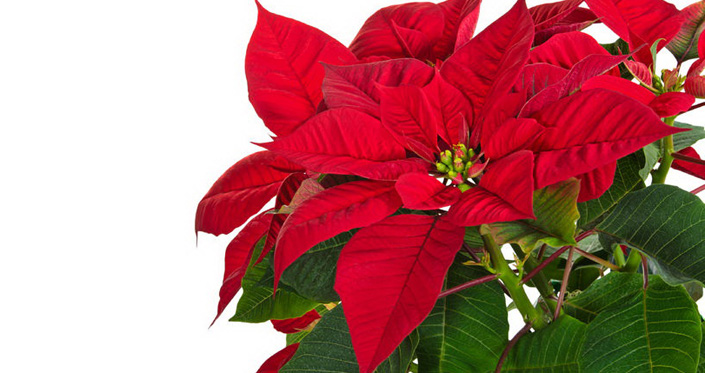
Poinsettia (Euphorbia pulcherrima) This plant is also called the Mexican flame leaf, and is native to Central America, near southern Mexico. Poinsettias are short day plants and it’s only when the daylight falls below 12 hours a day that they will even begin to think about starting to flower. For them to thrive, keep away from cold draughts and don’t overwater. As legend has it, a girl in 16th century Mexico had no money nor a gift for baby Jesus. Inspired by an angel, she brought roadside weeds that she’d picked to the altar and they miraculously burst into beautiful red flowers (poinsettias).
Wheat sheaves (Triticum spp.) In the lead up to Christmas in Ukraine, children look out for the first star in the eastern evening sky in memory of the trek the three wise men made. When this is seen, the head of the household brings in a wheat sheaf known as a didukh, a symbol of abundance, a good harvest, fertility and closeness to the earth and her resources. It is tied with colourful thread and kept as a decoration in homes.
Radish (Raphanus sativus) It may come as a surprise, but radishes are also a Christmas plant! On 23 December, in Oaxaca in Mexico, there’s a celebration called Noche de Rabanos (‘Night of the Radishes’). In the celebration, over-sized radishes are cut and carved into religious or cultural figures, especially those pertaining to Christmas.
The event has become very popular, attracting over 100 contestants and thousands of visitors. Since the radishes wilt soon after cutting, the works can only be displayed for a number of hours, leading to long queues of visitors.