

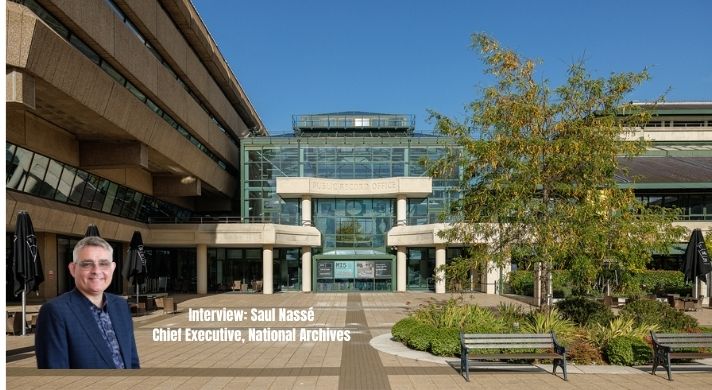
Saul Nassé: Guarding the National Archives
As Chief Executive of The National Archives, Saul Nassé is responsible for preserving Britain’s official memory – from medieval parchment to AI-era records. He talked to Pippa Duncan about his role and how to make the archives accessible to everyone
Here, on the edge of Kew, where runners loop past the swans and commuters glance across the water, sits one of the country’s quiet powerhouses. The National Archives holds the official memory of the nation – kilometres of paper and parchment and now ever-growing quantities of digital material – and at its helm is Saul Nassé.
Nassé has been Chief Executive for just under 18 months, a role that comes with some great job titles, including Keeper of Public Records and King’s Printer of Acts of Parliament. The latter stretches back more than 500 years and yet Nassé is refreshingly unfazed by the weight of history: ‘It’s an amazing organisation with lots of different facets,’ he says. ‘We’re the archive of government, but we also publish the law and control copyright. It’s quite hard to categorise us, and that’s what makes it interesting.’
Nassé has spent his career in content – first at the BBC, working on everything from Tomorrow’s World to Strictly Come Dancing India, and later in education. ‘This is all about content too,’ he explains. ‘But it’s historical content, and the collection here is extraordinary.’ Before joining, he knew what The National Archives was, but he wasn’t a user. ‘I’ve had the joy of discovering it as a user, and now I want many more people to do the same. It’s a fantastic treasure-trove.’
That sense of discovery runs through everything he says. The organisation now employs around 600 people, including specialists who work across the country supporting and inspecting other archives.
History is often influenced by what survives – and so, necessarily, is the Archives. For the last 150 years, record-keeping has been relatively systematic, but today’s challenge is the transition from paper to digital. ‘The volume is enormous,’ he says. ‘You simply can’t apply the same techniques that worked for paper and parchment.’ Government departments are responsible for selecting what comes to Kew, and increasingly AI will help them – and the Archives – decide what to keep.
That raises questions about truth and trust in an AI-driven world. Nassé sees archives as more important than ever. ‘Original documentation is what lets you tell truth from lies,’ he says. Yet he acknowledges that official records will increasingly be created using AI tools. ‘Do we archive the tools as well as the outputs? Those are very live questions for us.’
Balancing transparency with protection is another daily reality. Highly sensitive material may remain within certain secretive departments for a defined period, but it is still known, tracked and reassessed over time. Other records are held at Kew but closed to the public, often because of national security or personal data. Members of the public can request access under Freedom of Information rules, triggering further review.
That balancing act was vividly illustrated by the recent MI5 exhibition, which attracted 55,000 visitors – twice the usual number. Once an organisation whose very existence was denied, MI5 began depositing records at the Archives in the 1990s. The exhibition paired those files with physical objects from MI5’s own closed museum. ‘Over half the visitors had never been here before,’ Nassé notes. ‘That’s the power of something compelling.’
For him, a truly national archive is defined not just by scale – though Kew is by far the largest in the UK – but by trust. ‘When you put “national” in front of an organisation, there’s an instinctive trust. We have to repay that.’ Engagement matters too. There is little point, he says, in preserving hundreds of kilometres of records if no one uses them.
Younger audiences are a particular focus. Academics and genealogists remain core users, but exhibitions, talks, school visits and even the café play a role. ‘It’s a bit like television,’ Nassé reflects. ‘You might have a specialist theme, but you need a treatment with broad appeal.’ Digitisation and smarter online search, powered by AI and handwriting recognition, will extend that reach far beyond Kew.
Asked about hidden gems, Nassé resists nominating a single document. Instead, he urges visitors to follow their passions. ‘Everyone is interested in something, and there will be a history of that something here.’ His own discoveries range from his grandfather’s 1950 naturalisation certificate to early Elizabeth Line plans (trains being a passion of his), Festival of Britain architecture and historic beer labels.
There are still moments of genuine surprise, he notes. A Shakespeare family will from 1642 was recently uncovered in a box of Chancery documents, unseen by modern historians and instantly sparking debate. And British humour, too – like Harold Wilson’s handwritten dismissal of a proposal from Tony Benn: ‘I haven’t read it, I don’t propose to, but I disagree with it.’
Working daily in the shadow of history inevitably shapes his outlook. Knowing that today’s decisions will become tomorrow’s records encourages care and reflection. ‘If you understand history, you understand contemporary issues,’ he says. ‘Politicians are often juggling the same problems as their predecessors. Looking back can help you look forward.’
His final message is simple. ‘Come along,’ he urges. ‘This is a fantastic asset to the nation. Right here on our doorstep is an absolute national treasure – and unlike most museums, you can order up the collection and hold history in your hands.’
Find out more about the National Archives
Find out about other local people here.