

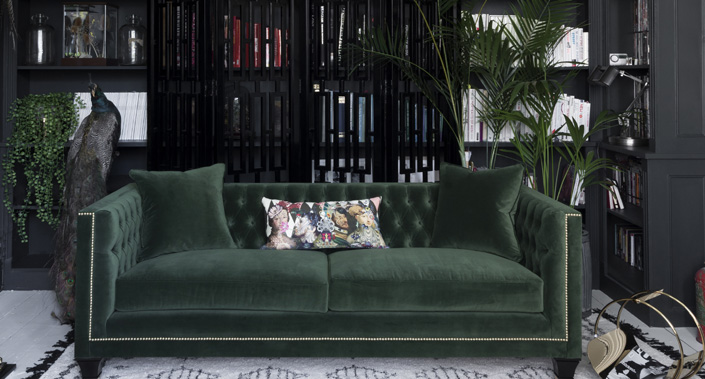
Sophisticated, intense and eye-catching – use black in your interior to create drama, interest and on-trend style
To make an impact when designing a room, sometimes it pays to go against convention. This is why the use of black in an interior is so surprising and, when employed with thoughtfulness and flair, so successful. What could be more different to the typical room with all-white walls than one that uses a significant amount of black?
This timeless colour is bold, luxurious and actually more versatile than you might think. For a start, just as there is a huge variety of shades of white, so there are many different shades of black, ranging from cool, blueish blacks to warm, red-blacks. Looking carefully at paint swatches and then testing the paints out on your walls (examining them at different times of day and under various lights) will demonstrate their underlying tones and help you determine what works best for your room.
Secondly, bear in mind that although black itself is dark, the room in which it is used doesn’t have to be. Yes, in a small room, such as a snug, WC or study, black can be used to emphasise a feeling of cosiness, but in a larger space it can help improve the sense of proportion and create a feeling of intimacy. To avoid a sense of gloom, ensure that any room in which you plan to use significant amounts of black has both large windows and plenty of reflective surfaces (glass, mirror and gloss paint) to provide daytime illumination, and include a good variety of artificial lighting – ceiling and wall lamps, floor and table lamps – to create gorgeous pools of warm, welcoming light at night.
If all-over black is a step too far, employing black as a strong accent within a room is an excellent compromise. This could mean covering a wall or two in black to provide a strong contrast to your furnishings, or perhaps painting around the room below the dado rail, creating a comfortable sense of grounding. Black can work exceptionally well for wall-to-wall bookshelves or as a run of kitchen cabinets. Or you might prefer simply to choose a selection of smaller accessories in black – picture frames, table lamps or a side table, for example – to give a crisp, graphic look.
However, you decide to use black, it will always need to be combined with other colours. Just as a little black dress looks great with a bold necklace, black walls team brilliantly with, for example, a brightly coloured sofa, vivid paintings, a jewel-bright headboard or a colourful rug. It’s a contrast that really catches the eye, and a dark backdrop harmonises wonderfully with intense colours such as crimson, orange, lime, fuchsia, yellow, emerald and mustard (though not so well with darker colours such as purple, navy or chocolate). The strongest contrast of all, of course, is black with white. This combination can be fresh, crisp and contemporary, though pure black and white may end up being a little simplistic, and best tempered with some greys (if you wish to stick with the monochromatic look) or other colours, and definitely with a variety of patterns in differing scales, and with textural detailing. Black with neutrals and naturals also works well – adding timber, stone, hessian, linen, sisal, wicker and wool, for example, in their natural range of beiges, browns, creams and greys, is softening and beautiful. As interiors experts say, even just a touch of black is vital in every room, enhancing the colours, patterns and shapes that surround it.
Box: What is black, and how black is it?
Colour, in a scientific sense, is the range of visible light seen by humans. Black, being an absence or complete absorption of light, is therefore not considered to be a colour. If, on the other hand, you consider colour in terms of pigment, then black is actually a mix of yellow, red and blue, the three primary colours. Rather than not being a colour, it’s actually all the colours! Pure black, in scientific terms, can only be found in a black hole, and until recently the blackest black on earth was a pigment called ‘Vantablack’ that absorbs 99.96% of all light, developed by British company NanoSystems for military and astronomical use – and now reserved exclusively (and somewhat controversially) by the artist Anish Kapoor. In September last year, however, scientists at prestigious American research university the Massachusetts Institute of Technology developed (by accident) an even blacker coating that absorbs at least 99.995% of incoming light. The search for a completely black black continues…
(Balfour designer sofa, £965, Sweetpea & Willow: 0345 257 2627; www.sweetpeaandwillow.com.)
Find other Homes & Interiors articles here.