

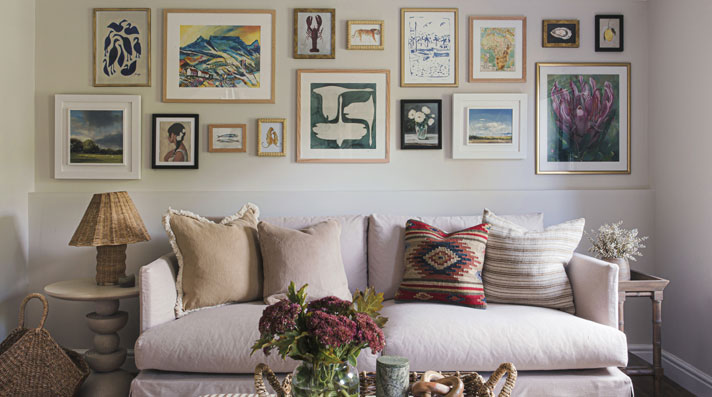
Create a gallery wall
Use gorgeous artwork and photographs to create instant impact, writes Katherine Sorrell
Grouping pictures to hang together to create a gallery wall can create a striking decorative effect and is a great way to display your treasured memories or artefacts. Our guide will help answer your questions about hanging wall art effectively.
Where should I hang my pictures?
The short answer is wherever you like. The longer answer, however, is that a wall of art is most effective in larger spaces where there is room to stand back and appreciate it. The living room is an obvious choice, but you can site much-loved pictures in any of your most frequently used rooms to enjoy them as often as possible. It could be a bedroom, the dining room, a home office or even a hallway; any favourite spot is fine, provided the work is not likely to be damaged by its location (too hot, humid or likely to be splashed, for example).
Keep precious pieces, especially watercolours and photographs, out of direct sunlight unless protected by special glass. And bear in mind that bright light will cause reflections on glass-fronted pictures opposite windows.
What is the best background?
Just as in many art galleries, neutral walls (usually white) can be a great foil for a collection of art, focusing on them without undue distraction. Some galleries have, however, turned to dark walls on which to hang their masterpieces, choosing a shade that enhances the works without overpowering them. For a country-cottage effect, you may even try hanging a group of gently coloured pictures against patterned wallpaper in complementary shades.
What’s the simplest option for hanging groups?
Undoubtedly the easiest way to hang a group of paintings that correspond in terms of size, shape and frame material (and perhaps in subject matter and colour) is to hang them in a row, a series of rows or another ordered, geometrical arrangement. The effect is formal and traditional, though this can be undercut depending on the style of frame and the works themselves.
How can I create a true ‘gallery’ effect?
To create a gallery wall, if you have a more disparate collection, start by laying the pieces on the floor and assessing how they look together. If necessary, remove some, make substitutions or consider re-framing – matching or similar frames can really help to pull a less regular arrangement together.
Try to see them as a whole and group them roughly into an overall rectangle or aligned on three sides. On the other hand, a completely free-form arrangement can be intriguing, though it helps if the ‘ingredients’ possess at least one common factor, which could be shape, size, colour, texture, material or subject.
How high should I hang my pictures?
It’s a common mistake to hang artworks too high. When planning your gallery wall, it’s good idea to make the centre of your grouping roughly at eye level (around 1.55 metres) – taking into account the height of your ceiling and where your furniture is placed.
What about lighting?
Lighting artwork can become very technical, but it’s nice to ensure your beautiful grouping of favourite pieces can be enjoyed after dark. Custom picture lighting is the optimum choice, usually either a discreet track system, ceiling-mounted spotlights or a traditional picture light or two (depending on the size of your gallery wall).
If re-wiring isn’t an option, consider battery-operated, rechargeable picture lights, or simply position floor or table lights carefully and direct them at your artworks, avoiding glare if possible. Professionals recommend LED bulbs for their small size, low energy use and because they do not heat up. Look for bulbs with a colour temperature of 2,700 kelvins and a slightly yellowish to neutral warm white to ensure that your gallery looks its very best.
Find other Homes & Interiors features here.
Image: This beautifully considered gallery wall in a room designed by Claire Garner works on a linear principle but with a delightful variety of sizes. Claire Garner Design Studio clairegarnerinteriors.com