

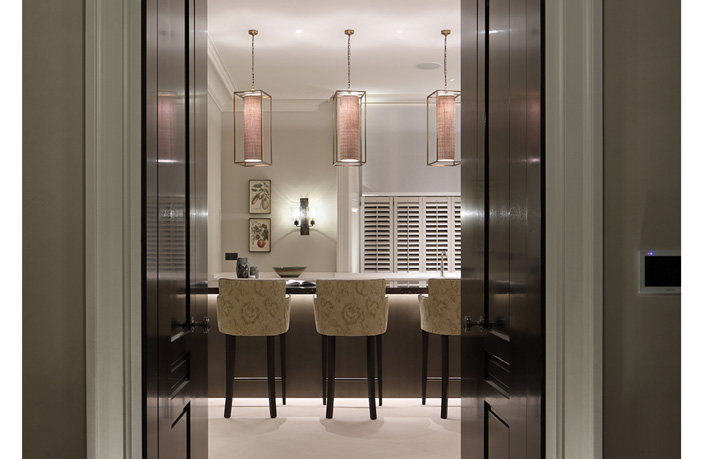
During the dark days and long nights of winter we rely on artificial lighting for both function and a sense of comfort and vitality. Now’s the time to assess what works in your home and plan any necessary improvements, writes Katherine Sorrell
Plan lighting as early as possible
If you are redecorating, consider whether it would also be a good time to upgrade your lighting scheme. Perhaps adding some wall lights above the seating in the living room would give greater flexibility, while wall lights mounted either side of a bed will free up space on the bedside table. How about a row of lights over the dining table? A picture light above a favourite painting or photograph? Or some spotlights to provide good working light above your home-office desk? If you are replastering anyway, the necessary wiring may not be overly difficult to incorporate and the results will be well worth the effort.
Light in layers
Design your lighting so that it comes from several different sources and directions, the idea being to ‘layer’ it for both practicality and aesthetics. Think of it as painting with light, creating washes and filling in with highlights and lowlights. Professionals think of four types of lighting: general, task, accent and atmosphere, and you can mix several types in each room using a combination of ceiling lights and pendants, wall washers, floor or table lamps, and special shelf or picture lights.
If you are stuck with a dull central pendant, and structural changes are not possible, it is still easy to introduce flexibility by adding floor and table lamps for better illumination at mid and higher levels around the room. With judicious placement these will provide both improved functionality and visual variety.
Get the best bulbs
Don’t put up with energy-guzzling light bulbs that are too dazzling, too dim, too white or too yellow. It is a simple matter to replace them with ones that are the right brightness and colour – and it may save you money in the long run, too. The old-fashioned energy-saving bulbs that we all know and hate used to take forever to turn on, but modern LED versions become bright instantly. Although expensive initially, they are cheap to run and should last for years (or even decades). For a warm, welcoming light, look for bulbs marked around 2,700K (kelvins measure the colour temperature of a bulb; the higher it is, the whiter the light). As for how bright they will be, this is undoubtedly confusing. Don’t think in watts any more (this is a measure of how much energy the bulb consumes); instead, it’s all about lumens (lm), meaning brightness. If you want the equivalent of a 40w bulb, you’re looking for around 470lm, while a 60w equates to around 800lm. The packaging should explain it clearly. Another point to note: dimmer switches make all lightings schemes more versatile, but it can be trickier to dim LEDs, so consult your electrician before investing in any specific fittings.
The latest in lighting
Lighting technology is moving fast. LED lighting has changed the game, allowing for very small, slim fittings in places that were not previously possible. Strip lights can be placed around the home to create interesting effects, while the energy efficiency of LED means that cordless, battery-powered lights can be placed almost anywhere. Meanwhile, ‘smart’ lights that wake you up, turn on as you walk into a room or change colour in time to your music are all pretty standard these days, and you can control them via an app, a remote control or even voice commands. Look out for futuristic innovations such as lighting that supports bio-rhythms via adjustable light levels (avoid that post-lunch low!) and light panels that look like skylights, incorporating a horizon effect, to bring ‘daylight’ into windowless areas. What else will new technology bring? One thing’s for sure: the future’s bright.
Lighting regulations
All electrical work in the home in the UK must comply with Part P of the Building Regulations, so for anything other than the most minor works you should use an electrician who is registered as a ‘competent person’. Remember that lights fitted in bathrooms and outdoors must be specially rated. Known as an ‘ingress protection’ rating, this is usually at least IP44, but it is essential to check with your supplier and/or electrician before installing.
More Homes & Interiors articles here.
Image: John Cullen